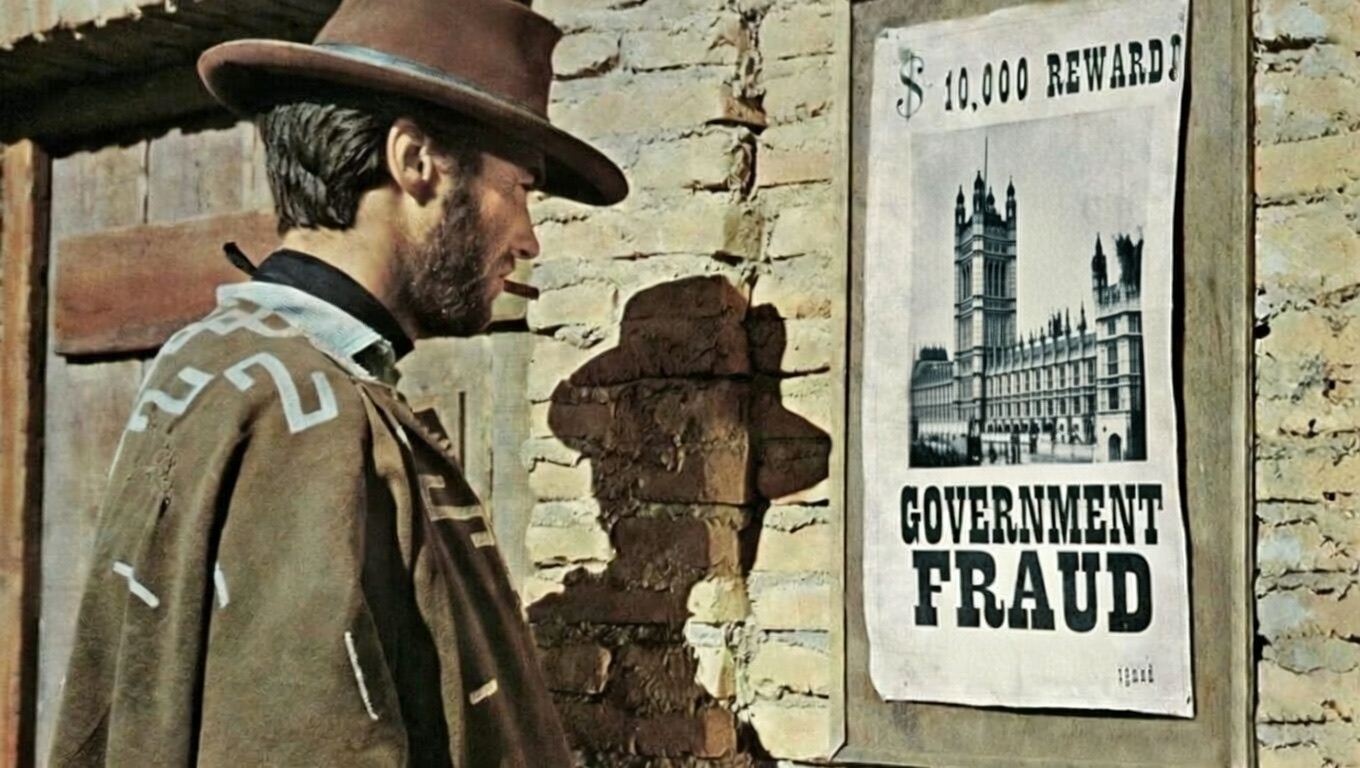


Imagine you uncover fraud against the government. Imagine you report the perpetrator and they’re found guilty. Imagine you get £266m as a reward.
This is a reality under the False Claims Act in the US. It effectively turns private citizens into fraud bounty hunters. If you can prove that someone has defrauded the government, you can sue on the government’s behalf, and, if the case succeeds, receive a share of what the state recovers.
Should we bring it back to Britain?
Fraud in Minnesota
This act gained some attention recently after Nick Shirley’s viral video, where he doorstepped several Somali-run child day care centres in Minnesota that appeared to have no children enrolled. This brought attention to the massive public fraud in the state, mainly involving Medicaid, childcare, and other public assistance programmes.
This wasn’t a new story. In 2021, federal law enforcement started probing a series of multimillion dollar fraud schemes, which have led to federal charges against 92 people with 62 convicted, and counting, most of whom are of Somali descent. It's estimated that $9bn of taxpayer money may have been lost to fraud. For scale, that’s more than the GDP of Somalia, or enough to fund the NHS – for 13 days.
When Shirley appeared on the All-In Podcast to discuss his video, the hosts suggested he make money from it by using the False Claims Act.
You don’t even have to be an American citizen to benefit from it. A 34-year-old British scientist from Oxford, who spends his spare time trawling through peer-reviewed science papers, recently earned £2m (a share of the £12m settlement) for exposing the use of falsified data by one of America’s leading cancer research institutions. Last year, he took a three-month holiday to cycle to China. This year, he’ll be able to afford a car.
The good old days
The False Claims Act derives from an old piece of common law – a writ of qui tam. This is short for the Latin qui tam pro domino rege quam pro se ipso in hac parte sequitur, meaning “[he] who sues in this matter for the lord king as well as for himself.”
There are early precedents in Roman and Anglo-Saxon law, but the first qui tam statutes were enacted by Parliament in the fourteenth century. Fast forward a few hundred years and the American colonists were using it.
It became big business during the American Civil War, when defence contractors were selling the Union Army defective weapons, decrepit mules, and rotten food faster than federal prosecutors could investigate. In 1863, Lincoln signed the False Claims Act to curb this behaviour. The Act was defanged somewhat during the Second World War, when the US government was rushing to sign large military procurement contracts, but it was strengthened again in 1986. Since then, it’s recovered over $70bn for US taxpayers.
But in Britain, just when our erstwhile fellows were enshrining it in law, we killed it.
As with so many things, busybodies are to blame. The practice fell into disrepute in the 19th century because ‘common informers’ – described in an earlier time by Jonathan Swift as “a detestable race of people” – were using it for petty moral enforcement. One such detestable was Millie Orpen, a solicitor's clerk, who in 1931 brought an action against a cinema for opening on Sunday, winning herself £5,000. She gave it another go later the same year(!), but was thwarted by a change in the law. The Common Informers Act of 1951 then ended qui tam in Britain.
Vexatious claims are less of a concern now. The False Claims Act includes safeguards against abuse: courts can dismiss frivolous cases, the government reviews all claims before they proceed and can intervene to control litigation, and defendants can recover legal costs from bad-faith litigants.
Britain’s fraud problem
Could a return of qui tam help tackle the fraud and broader public finance rot that now dogs Britain?
In 2023-24, fraud and error cost the taxpayer up to £81bn – but only a fraction of that was detected and known about. Benefit overpayments due to fraud and error were estimated at £9.5bn for 2024-25. And the stories pile up. There’s the 222 active fraud investigations into Tower Hamlets Council, mostly around potential housing fraud. (As EY diplomatically puts it in its report, “in our view the Council has a higher degree of ‘other’ investigations related to Council employees or members than other local authorities within our portfolio. This level of workload can be symptomatic of a weak control environment that fails to deter or prevent incidences of fraud.”) The Midlands NHS trust’s questionable £40.5m overseas doctors training scheme. The Bulgarian benefit fraud gang, one of whom appears to be out and on benefits again.
At the moment, investigation into all of this is carried out by the inefficient machinery and endless independent reports of the state – just look at the Covid fraud.
Qui tam does two things. It distributes fraud detection to taxpayers who are already motivated to stop the waste or fraudulent use of their money (and motivates them further with a 15-30% share of potentially billions), and takes it out of the hands of the bureaucracy that created the exploitable system in the first place.
Even if a suspicious case turns out not to be fraud, but a downstream result of bad policy – the sort of stuff that, as entrepreneur, investor and one of the All-In “besties” David Friedberg viscerally puts it, doesn’t pass the vomit test: “Would you throw up in your mouth when you heard the news?” – the incentive still encourages people to dig into it. For example, special education needs spending looks like it’s brewing into a scandal and London councils paying over £1.1bn to “redacted” individuals in just seven months seems questionable. Neither necessarily involves fraud, but they’re worth investigating. If the state can’t guard its own taxpayers from fraud, why not let taxpayers try and pay them to do it?
This could be a new business model for investigative journalism. At the moment, you either have to work for a newspaper, bankroll yourself, rely on donations, or run a model like Hunterbrook. Hunterbrook publishes investigative journalism, and generates revenue by partnering with law firms on litigation (taking a share of damages or settlement, if successful) and taking both long and short positions through its sister fund. That model doesn’t work as well for fraud touching the government.
Our friends over at The Antifraud Company have built a model around qui tam: AI detection plus investigative journalism plus litigation. It is essentially DOGE for the private sector, protecting American taxpayers from corporate fraudsters. And with luck it will be more successful. Elon Musk’s ill-fated attempt at cutting back $2tn of US government expenditure managed just over a tenth of that. Watch Harriet’s interview with CEO and Co-founder Sahaj Sharda.
Could we have something similar in Britain?
A return of qui tam?
HMRC does offer rewards for reporting tax fraud – and has recently introduced a new Strengthened Reward Scheme for tax evasion cases – and the Competition and Markets Authority pays for cartel tip-offs. But these schemes aren’t widely publicised, and rewards have typically been discretionary and modest.
However, there have been noises about qui tam’s return. The now Minister of State for Defence Vernon Coaker proposed reintroducing it in 2007. More recently, the Director of the Serious Fraud Office (SFO) called for better financial incentives for whistleblowers, following the introduction of the Failure to Prevent Fraud offence, which closely mirrors the False Claims Act but, crucially, includes no qui tam provisions.
The fact that both HMRC and the SFO are now taking whistleblower rewards more seriously suggests the situation’s bad enough to warrant them.
Restoring the social contract
Qui tam isn’t a perfect system. As always, the lawyers win. In the US, whistleblower programmes are dominated by no win, no fee law firms who specialise in filing claims and take a cut of the awards. At the SEC, more than half of 2024’s ~25,000 tips came from just two sources.
But using market forces has to be better than what happens now – which is next to nothing.
The state itself creates the problem. First off, when a service is provided by government – taking your kids to school, collecting your bins – it eliminates any consideration of value. If you pay for something out of pocket, you have an incentive to get the best value for that product or service; that incentive disappears when the government steps in: the person using the service has no visibility of the cost to the taxpayer, and the government doesn’t much care about value, because it can always raise taxes, borrow more, or (as modern monetary theorists would have it) simply create money (and simply making its citizens poorer in the process via inflation).
Second, each time government establishes a new scheme, budget, or programme, it creates a pool of money with eligibility rules. These ringfenced pots are targets for fraud. And the bigger and more complex the eligibility criteria, the more opportunities for fraud. The system generates its own entropy.
The point is to use an established legal and market mechanism to fight back against that entropy. The state’s answer is always more bureaucracy: the independent review or public inquiry, which are expensive ways, both in time and cost, to get nowhere slowly. If qui tam makes a return to Britain, taxpayers would be incentivised to be the protectors of their own money, rather than relying on the slow machinery of the culprit, the state.
Indeed, if you look at some of the early qui tam statutes, the legal philosophy behind them is more than just “monetary incentives to fight fraud”. They were used to regulate public functions and curb the wrongdoing of public officials.
For example, a 1442 English law provided that “no [customs official], controller of the custom, clerks, deputies, ministers, nor their servants … shall have any ships of their own … nor they shall not meddle with freighting of ships … upon the pain … to be forfeit … one half to the King, and the other half to him that will sue in this case.”
As William Blackstone, eighteenth-century English jurist, judge and legal scholar, whose commentaries provided the first authoritative gloss on English common law, explained, “[t]he party offending is here bound by the fundamental contract of society to obey the directions of the legislature, and pay the forfeiture incurred to such persons as the law requires.” So, there is “an implied original contract to submit to the rules of the community, whereof we are members,” and when these rules are violated and a forfeiture imposed on the wrongdoer, the forfeiture satisfies “a debt in the eye of the law” to the injured party and the public in general.
In short, qui tam meant that private individuals were statutorily empowered to advocate for public interests and enforce the social contract in place of public officials.
At a time when democracy is showing its age and the social contract in Britain is fraying – being taxed more and more for less and less – this might be just what we need to hold the government to account, for its own sake and for ours.
Authors
.png)